
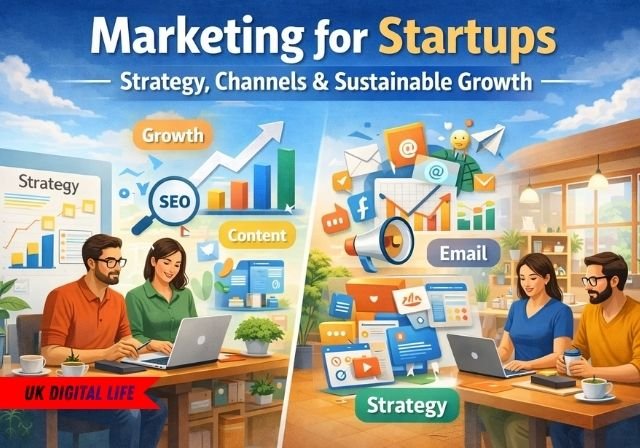

Marketing for startups is no longer about shouting the loudest or copying what big brands do. It is about clarity, trust, and measurable progress.
In today’s market, startups compete not only with other startups but also with established companies that already own customer attention. With limited budgets and time, founders must make smarter marketing decisions from day one.
This article focuses on what truly matters in startup marketing, using insights drawn from trusted industry research and real-world startup growth patterns.
What Marketing for Startups Really Means
Startup marketing is different from traditional marketing because startups operate with uncertainty. Large companies market proven products. Startups market ideas that are still being tested.
Industry research consistently shows that lack of market demand is the most common reason startups fail. Marketing exists to reduce this risk by helping founders understand whether people actually want what they are building.
At its core, startup marketing answers four questions:
- Who is the real customer?
- What problem matters most?
- Why should anyone care?
- Which message leads to action?
At this stage, marketing is not an expense.
It is a discovery and validation tool.
Audience Understanding Is the Foundation
Nearly every high-performing startup marketing analysis reaches the same conclusion: deep customer understanding drives growth.
Successful startups focus on:
- Clearly defined target users
- Real pain points, not assumptions
- Buying motivations and objections
- Where customers search for solutions
Companies that invest early in customer insight consistently outperform competitors in growth, retention, and profitability.
Broad targeting feels safe, but focused targeting converts better.
Branding Builds Trust Before Scale
For startups, branding is not about fancy visuals. It is about reducing uncertainty.
Early customers take a risk when choosing a new brand. Clear branding reduces that risk by:
- Communicating value simply
- Maintaining consistent tone and message
- Showing professionalism and credibility
- Avoiding exaggerated claims
Strong positioning often matters more than product complexity. Many startups succeed because customers understand them faster than competitors.
Strategy Over Activity
One of the most common startup marketing mistakes is trying to do everything at once.
Startups that focus on one or two core channels consistently perform better than those spreading efforts across many platforms. More activity does not equal more results.
Effective startup marketing strategies align:
- Business goals
- Target audience
- Chosen channels
- Clear success metrics
Without focus, marketing becomes noise instead of growth.
Marketing Channels That Consistently Work
Content Marketing and SEO
Content marketing remains one of the most cost-effective long-term strategies for startups.
Key benefits include:
- High-intent traffic
- Lower acquisition costs over time
- Authority and trust building
- Compounding growth
Content-driven strategies regularly generate more qualified leads at lower costs than traditional outbound methods.
Social Media Marketing
Social media works best for:
- Awareness
- Community engagement
- Direct feedback
Results depend on relevance and consistency, not follower count.
Email Marketing
Email remains one of the highest ROI channels for startups.
It supports:
- User onboarding
- Retention
- Product updates
- Relationship building
For SaaS and service-based startups, email is often critical to long-term growth.
Paid Advertising
Paid ads can deliver fast results, but they carry risk.
They work best when:
- Messaging is already validated
- Conversion tracking is accurate
- Budgets are tightly controlled
Ads amplify clarity. They do not create it.
SEO as a Long-Term Growth Asset
Search traffic captures users who already have intent, making SEO especially valuable for startups.
Startups investing early in SEO often experience:
- Noticeable traffic growth after 6–9 months
- Lower customer acquisition costs over time
- Stronger brand authority within their niche
High-performing startup content usually includes educational guides, comparisons, and real use-case explanations.
Practical Experience Insight
Across multiple early-stage startup growth studies, startups that validated demand through one primary channel before scaling others often reduced acquisition costs by 30–50% within the first year.
For example, many SaaS startups test demand using SEO-driven educational content before running paid ads. This allows them to validate messaging with real users while spending very little.
Learning first, scaling second, consistently outperforms aggressive spending.
Growth Marketing and Meaningful Metrics
Growth marketing focuses on improving the entire customer journey, not just traffic numbers.
Successful startups commonly track:
- Customer Acquisition Cost (CAC)
- Lifetime Value (LTV)
- Conversion rates
- Retention and churn
- Activation milestones
Data-backed decisions allow startups to scale predictably instead of guessing.
Marketing Tools Support Decisions
Marketing tools are helpful, but they are not magic.
Most startup marketing stacks include:
- Analytics and tracking tools
- SEO research platforms
- Email marketing software
- CRM systems
- Social media scheduling tools
Early-stage startups often rely on free or low-cost tools until growth justifies larger investments.
Budget Reality for Startups
There is no universal marketing budget rule. Industry benchmarks show many startups allocate 5–15% of revenue to marketing once revenue begins.
Effective spending patterns include:
- Small experiments before scaling
- Clear ROI measurement
- Preference for organic channels
- Avoidance of long-term commitments
Smart budgeting protects runway and improves learning speed.
Common Marketing Mistakes Startups Make
Across trusted industry research, the same mistakes appear repeatedly:
- Spending heavily before validation
- Ignoring customer feedback
- Chasing trends without strategy
- Measuring vanity metrics
- Using too many channels at once
Avoiding these mistakes often matters more than discovering new tactics.
How Marketing Evolves With Growth
Early-stage marketing focuses on validation and learning. Growth-stage marketing focuses on scaling proven systems.
As startups grow, marketing becomes more structured, automated, and brand-driven. Startups that treat marketing as a continuous learning process adapt faster and survive longer.
Final Thoughts
Marketing for startups is not about being everywhere.
It is about being clear, useful, and consistent.
Startups that invest early in understanding their audience, choosing the right channels, and measuring real outcomes build stronger foundations for long-term success.
Marketing does not just sell the product.
It shapes the future of the startup.
A clear understanding of what is electronic business also helps startups choose the right marketing channels and growth strategies.
About the Author
This article is written by a startup marketing researcher focused on early-stage growth strategies, customer validation models, and sustainable go-to-market frameworks.
Trusted Sources Used
- CB Insights – Startup failure and market demand research
- Harvard Business Review – Customer validation and growth frameworks
- HubSpot Blog – Content, inbound, and email marketing benchmarks
- Think With Google – Digital behavior and marketing trends
- Stripe Atlas Guides – Startup marketing and go-to-market insights
- Statista – Marketing and growth statistics
- McKinsey Insights – Customer-centric growth strategies
